
Per City Code, a physical piping connection between the City’s potable drinking water system and non-potable pressurized irrigation water systems is not allowed on residential properties. These piping connections, called Dual Connections, must be removed.
Dual Connection Removal Requirements
- Inspection and Approval
- All removal work must be inspected and approved by the City before any piping is covered.
- This inspection ensures the work meets City removal requirements.
- To schedule an inspection, call 208-985-1223 (Meridian Cross-Connection Control Section).
- Removal Process
The following pipe alterations are required when removing Dual Connections. The numbers in parentheses go with the image below.
- Remove the Main Valve (3), then plug or remove the tee and reconnect the home service line.
- Remove the Drain Valve (4) and Upstream Piping (5)
- Remove the Backflow Assembly (6)
- Remove the Downstream piping (7) and cap or plug underground
Dual Connection Example and Information
For information about a specific section of the dual connection example, please refer to the corresponding numbers below.
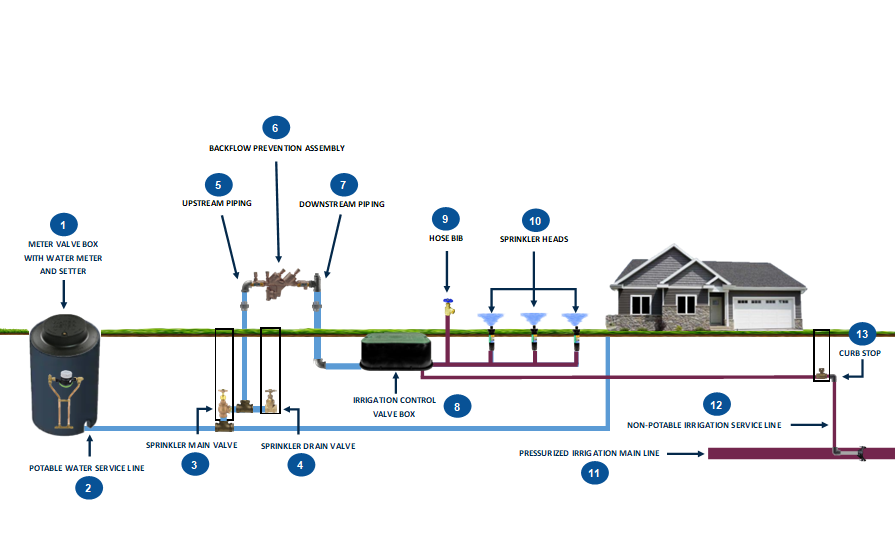
- Meter Valve Box with Water Meter and Setter – Normally located on the front left or right side of the property.
- Potable Water Service Line – This line connects the water meter to the customer’s home.
- Sprinkler Main Valve – On/off valve connected to the potable water service line and is used to feed water to the sprinkler system. Normally found in a tube near the backflow prevention assembly.
- Sprinkler Drain Valve – Used to drain water out of the upstream piping when needed. Normally found in a tube near the backflow prevention assembly next to the sprinkler main valve.
- Upstream Piping – Water piping connected from the sprinkler main and drain valves to the backflow prevention assembly.
- Backflow Prevention Assembly – Possible types of backflow prevention assemblies installed:
- Reduced Pressure Backflow Assembly (RPBA)
- Double Check Valve Assembly (DCVA)
- Pressure Vacuum Breaker (PVB)
- Downstream Piping – Water piping connected from the backflow prevention assembly to the sprinkler system.
- Irrigation Control Valve Box – Used to operate the sprinkler system.
- Hose Bib – Connected to the sprinkler system if installed.
- Sprinkler Heads – Connected to the sprinkler system.
- Pressurized Irrigation Main Line – This line, connected to other lines, delivers non-potable water to properties for their sprinkler systems.
- Non-Potable Irrigation Service Line – This irrigation service line connects the pressurized irrigation main line to the sprinkler system.
- Curb Stop – On/off valve connected to the non-potable irrigation service that feeds the sprinkler system. Normally found in a tube located in the backyard of a property.